
Tribe Kanin (ka-neen)
Guided by nature, illuminated by stars.
‧˚₊‧ ──────── ⟡ ──────── ‧₊˚⊹
On the edge of the Fyrir Confederacy, on the border of the Forn and the Midlands, there resides a small tribe of Stonerunners surviving in the steps of snow and ice. Like many tribes of the Fyrir, they are hunters and survivalists, living off the harsh land and becoming stronger for it. Tribe Kanin is located in one of the more challenging environments in the Amafells, between two imposing mountains posed on the border of their confederation. They are the threshold between the Fyrir and what lies beyond.
The Settlement of Haski’feth
The bite of the mountains begins here.
‧˚₊‧ ──────── ⟡ ──────── ‧₊˚⊹
Between the mountains of Muspel and Nifl lies the small settlement of Haski’feth that tribe Kanin calls home. The most important buildings are longhouses that are nestled in the few clearings the land provides. These include the homes of the prominent clans, the Matriarch and the tribe’s meeting hall. Other homes, halls and buildings are situated in caves along the mountainsides, or as outcroppings atop small plateaus. Although in terms of population, Haski’feth is relatively small, yet its physical area is rather expansive. In some cases, it takes an experienced mountaineer nearly an hour to travel from one abode to another.
For many travellers, Haski’feth is a brief stop on a longer journey into the Amafells or beyond. Although, without proper knowledge of the safe passageways through the mountains, it can be a highly perilous journey.
The Muspel and the Nifl
To the north of Haski’feth is the larger of the twin mountains, Muspel. Its rocky surface is often covered by thick, powdery snow that conceals many unfortunate pitfalls into deep crevices. Many inexperienced travelers meet their end by trying to traverse Muspel, believing it to be the safer of the two mountains. The peak of Muspel is also where the Last Light takes place, a unique funerary rite of the Kanin Tribe.
To the south is the mountain of Nifl and although its peak is shorter, it is not a climb to be taken lightly. Its surface is incredibly slick with large sheets of sheer ice. It has many steep cliffsides that members of Kanin’s youth use to learn how to ice climb. The largest of these cliffs is used as an integral part of the Gauntlet.
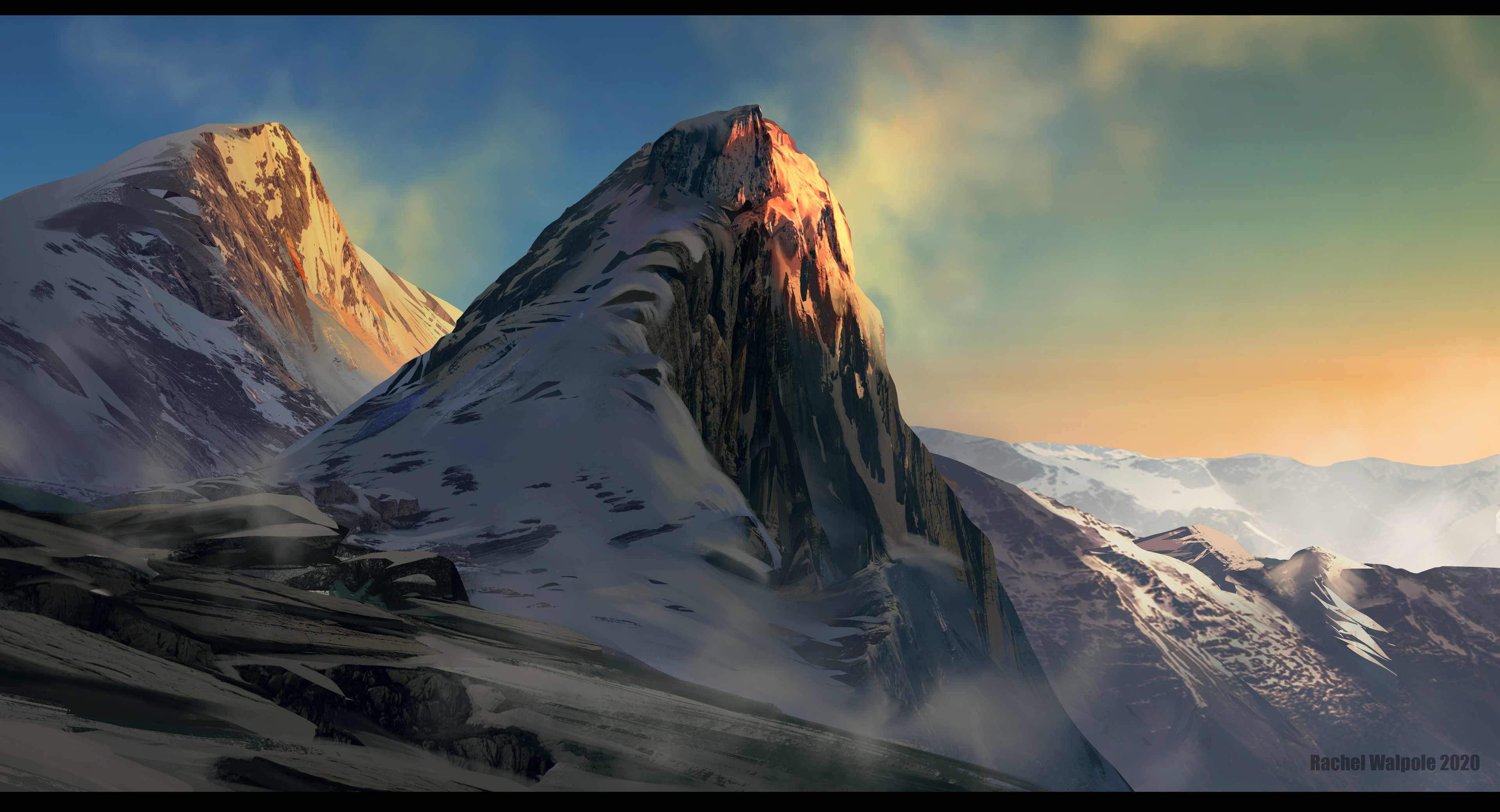
The peak of Mount Muspel. (Credit: Rachel Walpole, Sunny Mountaintop)
Alma’s Pass
Running uncomfortably close to Haski’feth is Alma’s Pass, one of the few marked pathways that provide a relatively safe journey through the Amafells and into the Faded Steppe. Legend has it that an ambitious Stonerunner named Alma charted the path and led expeditions for outsiders, much to the disdain of tribe Kanin. Today, this piece of knowledge has been passed onto many different travelers both of Stonerunner and non-Stonerunner descent. This has led to a great disruption to the Kanin way of life, forcing them out of their near-total isolation and thrusting them into a world where they must confront outsiders almost regularly.
These interactions are not met with open hostility however, instead most members of Kanin regard these travelers with a healthy amount of wariness and silent contempt. To usher them outside of their territory as quickly as possible, many Kanin scouts know Alma’s Pass well and will aid wayward outsiders in their travels, as far as their borders allow. Trade will also occasionally occur between tribe Kanin and the travelers and merchants of Alma’s Pass, however there are strict societal expectations when doing so.
Leadership & Society
By the cold grip of ice and steel, we will survive.
‧˚₊‧ ──────── ⟡ ──────── ‧₊˚⊹
In the last century, tribe Kanin’s way of life has seen a shift since the opening of Alma’s Pass. More travelers, more outsiders and more interaction with the outside world has caused the tribe to become more strict in their isolationism and traditions in an effort to protect their culture. Survival from elements, by the elements, is a creed etched into the bones of the Kanin. Luxury and the comforts it brings is looked down upon. Although not an official tradition, as its necessity has only surfaced in recent times, the societal enforcement of trade to be conducted only for what is necessary for survival has become commonplace within tribe Kanin.
Traditionally, there are two pathways for Kanin youth: the way of the hunter or the way of the scout. Both are admirable positions, but not always a fit for every member. Some may choose a more domestic life, becoming skilled in butchering the meat hunters bring home, forging weapons for scouts or learning the essential crafts of tailoring, cooking, building and other essential arts. Ensuring the day-to-day running of the clan is no less important.
Clans of the Kanin
There are three prominent clans within tribe Kanin, each with the power to cast a vote for the next Matriarch. These clans are Olander, Brink and Ekrot. Although not particularly large when compared to other clans in the Amafells, or even those among the Fyrir confederacy, they are considered the largest and most powerful of the Kanin.
Clan Olander is best known for their hunting prowess. Many of tribe Kanin’s best hunters and Skadirs come from this clan. Historically, they are also the clan with the most elected Matriarchs and currently has one of their members as the longest-reigning Matriarch to date.
Clan Brink specializes in border scouting, tracking and skirmishing. Both men and women of the Brink clan learn how to be warriors and are the first of the tribe to be called in for matters of defense. In times of peace, they aid hunters in tracking and hunting dangerous predators.
Clan Ekrot, while having members that are both prominent hunters and scouts, often facilitate the trade between the tribe and outsiders. When possible, they organize dead drop locations, and when not, they help with trade negotiations between the tribe and outsiders.
The Matriarch
Matriarch Brynhild Olander was elected on the precipice of change, and with a cold, iron grip she has suppressed any tides that may shift the Kanin tradition. She became Matriarch at the young age of 22, and has reigned for 58 years without being challenged or deposed. Now, in her elder years, she still remains a formidable and influential leader.
Among members of the Kanin, she is known to be a highly faithful believer in the guidance of the stars, as well as one of the most powerful Skadirs in the history of the tribe. She is seldom seen outside the borders of Haski’feth, however, and such isolationism has contributed to wild rumors about her true nature. Whispers of Matriarch Brynhild talk of her Goliath stature and towering presence. They speak of the twisted, gnarled horns that crown her head and the tusks as sharp as knives which protrude from her mouth. The truth of these claims are not widely known, but one thing is for certain, she clings heavily to the traditions of old, and possesses the might to defend them.
The Way of the Hunter
Many women of tribe Kanin learn the way of the hunt. They are taught by their foremothers how to string bows, track game across the frigid landscape, and survive for weeks off the land during long hunting trips. They are uniquely acclimated to the mountainous environment of their homeland and know the game of the land well.
To become a full-fledged hunter, a youth of the tribe must undertake the Hunt, an annual challenge that pushes their knowledge and strength to their limits. Succeeding in the Hunt allows a member of Kanin to truly be able to call themselves a hunter and lead their own hunting trips for the tribe.
Skadirs are hunters that have proven themselves to be a cut above the rest through either immense accomplishment or steadfast and unwavering dedication. They are often the ones to train the youth of the tribe in hunting and they play an integral role in facilitating the annual Hunt. They keep the knowledge of the tribe’s hunting trails, techniques and secrets, and verbally pass down this information to new generations. It is forbidden to write this knowledge down, it must only be learned through oral tradition.
The Way of the Scout
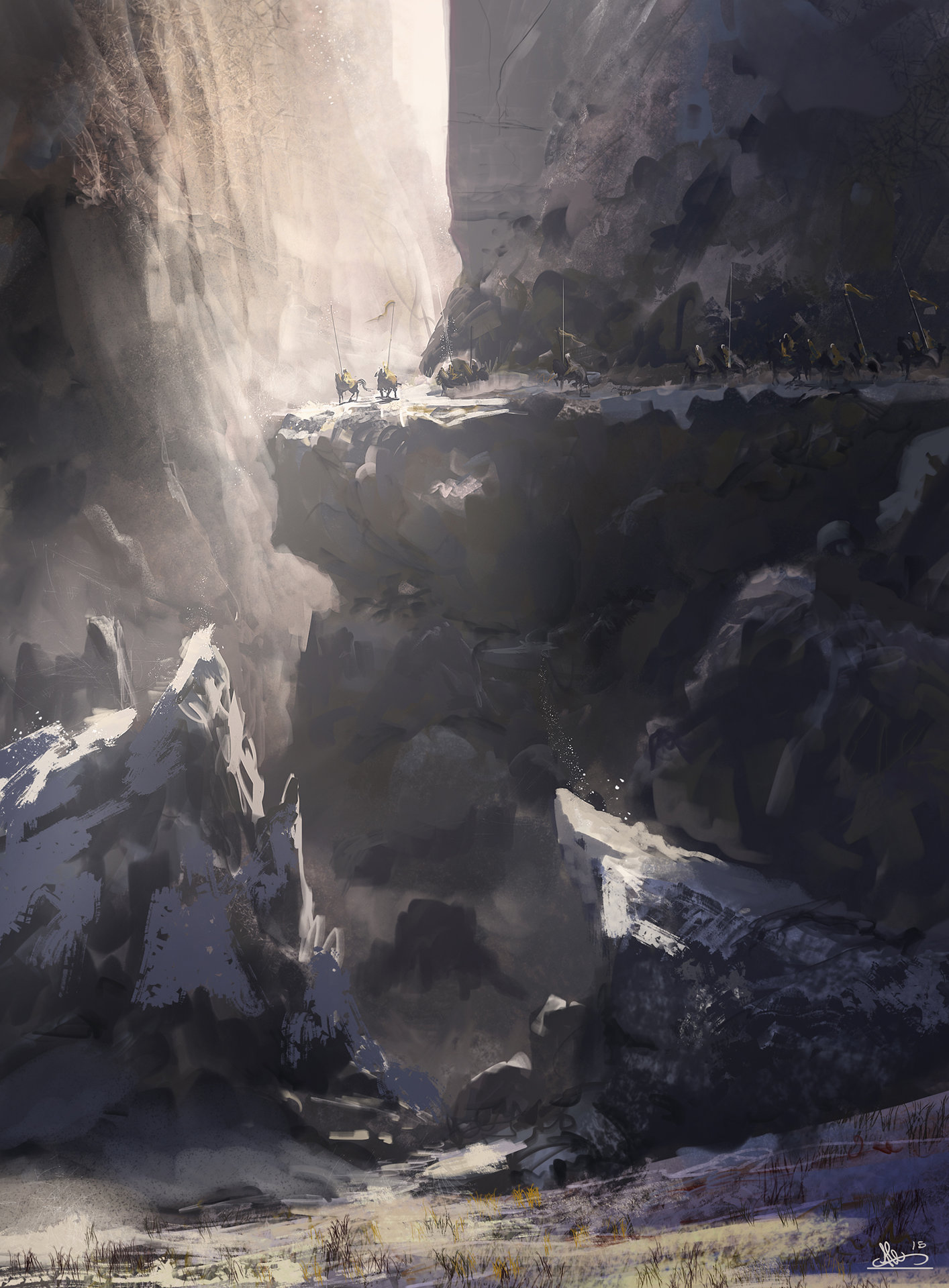
Many men of tribe Kanin choose the way of the scout. Ensuring the borders of their tribe and the confederacy as a whole are safe, and those traveling through are accounted for, is the job of a border scout. It is not an easy affair, as scouts are often away from home for weeks or even months.
Scouts are trained not only in spotting and tracking, but also in survival and martial skills. Should outsiders with violent intentions reach tribe Kanin’s borders, it is their duty to defend them and the tribe as a whole. On occasion, scouts will aid hunters in tracking dangerous predators in the territory.
In order to become a recognized scout, youth of the tribe must undertake what is called the Winter’s Gauntlet. This challenge is not to be taken lightly, and many have died attempting it.
A group of outsiders being led by scouts through Alma’s Pass. (Credit: Alejandro Olmedo, Mountain Pass)
Notable Rites & Traditions
Through winter’s march we persevere.
‧˚₊‧ ──────── ⟡ ──────── ‧₊˚⊹
While most of tribe Kanin’s traditions fall in line with that of the Fyrir confederacy, certain distinguished practices have evolved over time. The tribe’s extreme isolationism for most of its history has allowed for slight divergences in tradition.
The Hunt
The Hunt is an annual tradition that many young women of the tribe undertake in order to become fully recognized hunters. Skadirs will track and identify three beasts within the region. Potential hunters are then split into three groups and assigned a beast to hunt. Skadirs oversee these groups and evaluate their tracking and hunting skills, as well as their ability to work together. Should their skills be deemed satisfactory, and the beast they were assigned felled, they will return to the tribe as hunters.
The Hunt takes place over a week and, upon the final day, a grand feast is held in which the felled beasts are butchered. Their meat is cooked, while their pelts and bones are preserved for use in crafts and clothes. Many hunters adorn themselves in clothes or carry handmade trinkets made out of the bones or pelts obtained from their Hunt.
Winter’s Gauntlet
In the dead of winter, over the course of three months, youths of tribe Kanin will undergo the Winter’s Gauntlet in hopes of becoming a scout. The Winter’s Gauntlet is an annual challenge that puts a person’s survival and tracking skills to the test by making them follow a set route through the treacherous mountains of Muspel and Nifl. The route is changed from year to year, but always includes an ice climb on Nigel’s sheerest ice peak.
Participants are given no maps, just a series of landmarks. They must use their own knowledge of the land combined with their knowledge of the stars to make it to each landmark and plant a bone with their name carved into it. If a landmark is skipped, they fail. If they get lost, oftentimes the winter claims them and their bodies are found some time later. By the end of the three months, participants should have made it back to Haski’feth, with a festival and ceremony waiting to be held in their honor.
Last Light
Being a deeply spiritual people, tribe Kanin holds the stars and their guidance in high regard. It is their belief that once deceased, a body should burn close to the stars they once followed. The Last Light is a funerary rite reserved for Skadirs and Matriarchs of the tribe. It takes place on the peak of Muspel and the burning begins at midnight. During the Last Light, a body is stripped of its possessions, which are then passed down to members of the family. The fire is not hot enough to burn the bones of the deceased. These bones are interned in familial barrows.
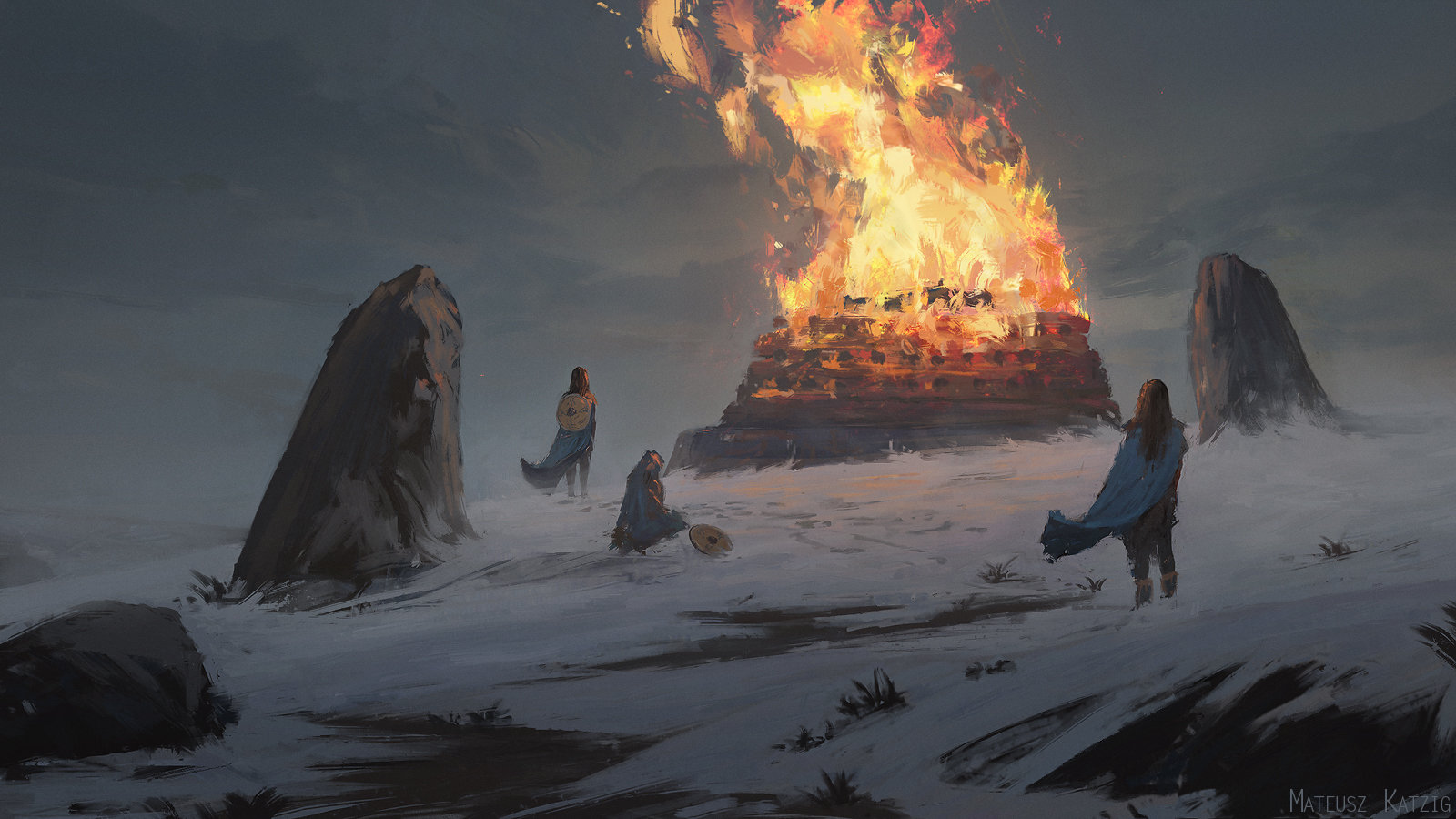
A Skadir’s Last Light being held on Mount Muspel. (Credit: Mateusz Katzig, See you in Valhalla)
Blood for Blood
The philosophy of punishment in tribe Kanin encompasses the idea of you reap what you sow, just as nature dictates. The Blood for Blood rite is a special sort of judgement executed by the Matriarch when settling disputes. When Blood for Blood is invoked, it is usually in cases of severe grievances, such as assault or murder. This method of punishment stipulates that should blood have been spilled, blood must be paid in response. Since Haski’feth lacks the infrastructure to keep prisoners, this swift form of justice is employed instead. Should someone cleave another’s arm off in dishonorable combat, their arm will be taken in response. Should someone murder another, their life will be taken accordingly. Betrayal of the tribe is seen as a spiritual spilling of blood, as the perpetrator has abandoned the clan, so too will the clan abandon them and they will be exiled as punishment.
Matriarch’s Decennial Fara
Many years ago, the founding Matriarch of tribe Kanin started the tradition of making pilgrimage to Notthof every ten years to receive prophecy from the Diviners. This practice was continued by the Matriarchs that came after her, before becoming an official tradition. The Decennial Fara is an integral part of a Matriarch’s life as it proves her dedication to the guidance of the stars, and allows her to impart that guidance onto the tribe. It brings comfort to tribe Kanin’s members both for the guidance itself, and in the knowledge that their Matriarch is strong enough to make the journey. Should a Matriarch not return, scouts will venture out to retrieve her body. If a Matriarch becomes too weak to make the trip, it proves she has become too old to lead and will either voluntarily step down, or be deposed.
The White Beast’s Reign
The legend of the White Beast is more of a myth than a tradition, but the stories of its reign have been passed down through generations. Legend has it that the White Beast resided in the mountains of Muspel and Nifl since long before tribe Kanin settled there. No one has seen a clear look at it, only a large, furred beast with striking white fur that is barely distinguishable from the snow and ice. It is said to guard the mountains from interlopers and that its presence brings bad luck to those that spot it. However, this is where the legend diverges. Some stories insist that the White Beast is a benevolent beast that only acts in nature’s good faith. Others insist it is a curse upon the land, siphoning away the lifeblood of the mountains, and that by felling it, the tribe and its people will receive good luck and large bounties for the next millennium.
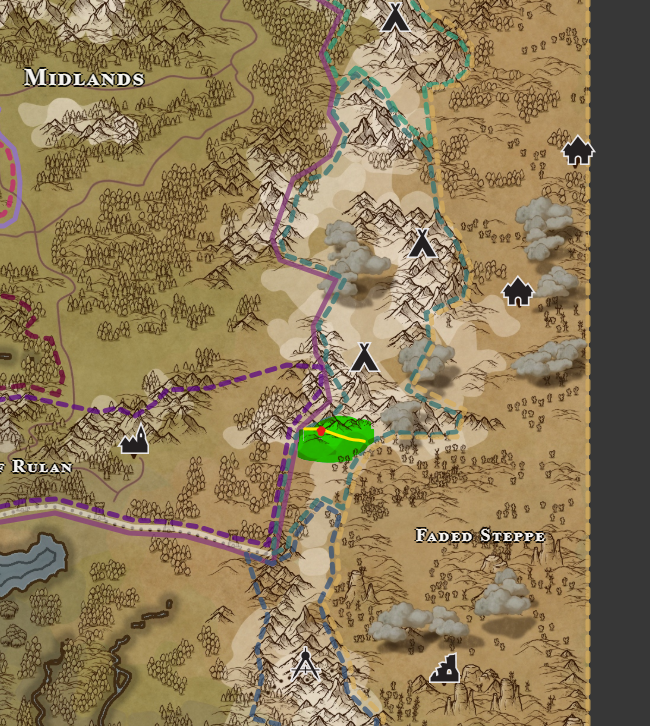
Depicted above is the location of Haski’feth labeled in red, the Kanin’s patrol and hunting grounds labeled in green, and the location of Alma’s Pass labeled in yellow.

